


Two cafés on the same street. Same roaster, same grinder, similar baristas. One serves espresso that tastes identical at 9 am and 6 pm. The other has customers who quietly stop ordering after 4 pm.
Nine times out of ten the difference is not skill. It is the group head. That heavy metal block your portafilter locks into is where brew water finally meets coffee, and how it holds temperature decides whether your recipe survives a full day of service. Most spec sheets for semi-automatic espresso machines mention the group design in one line and move on. It deserves more attention than that.
What a group head is actually doing
Your boiler might sit perfectly at 93°C. That number means little if the water loses two degrees on its way through the group, or if the group is cold because nobody pulled a shot in twenty minutes.
The group head has three jobs: deliver water at a stable temperature, spread it evenly across the coffee bed, and hold that temperature while nine bars of pressure push through. How a manufacturer solves those three problems is what separates E61, saturated and semi-saturated designs.
The E61: the classic that refuses to retire
Designed in 1961 by Ernesto Valente for the Faema E61, this group is still in production six decades later, which tells you something.
It runs on a thermosiphon. Hot water rises from the boiler into the top of the group, cools slightly, becomes denser, sinks back down through a return pipe, and the loop repeats on its own. No pump, no electronics. Several kilograms of brass act as a thermal flywheel, absorbing heat and releasing it slowly. Lifting the lever also gives you gentle mechanical pre-infusion, letting the puck settle before full pressure arrives.
Where E61 struggles is back-to-back volume. That brass mass needs 25 to 30 minutes to come up from cold, and during a long run of consecutive shots the group cools faster than the thermosiphon can replenish it. Shot one and shot eight are not always the same shot. For a boutique café or a serious home setup, that variance is small. On a 300-cup day, it shows in the cup.
Saturated groups: the group is part of the boiler
A saturated group takes a different route. Instead of circulating water out to a separate block, the group is built into the brew boiler itself. Boiler water surrounds the brewing chamber directly, so the group is not near boiler temperature — it is at boiler temperature.
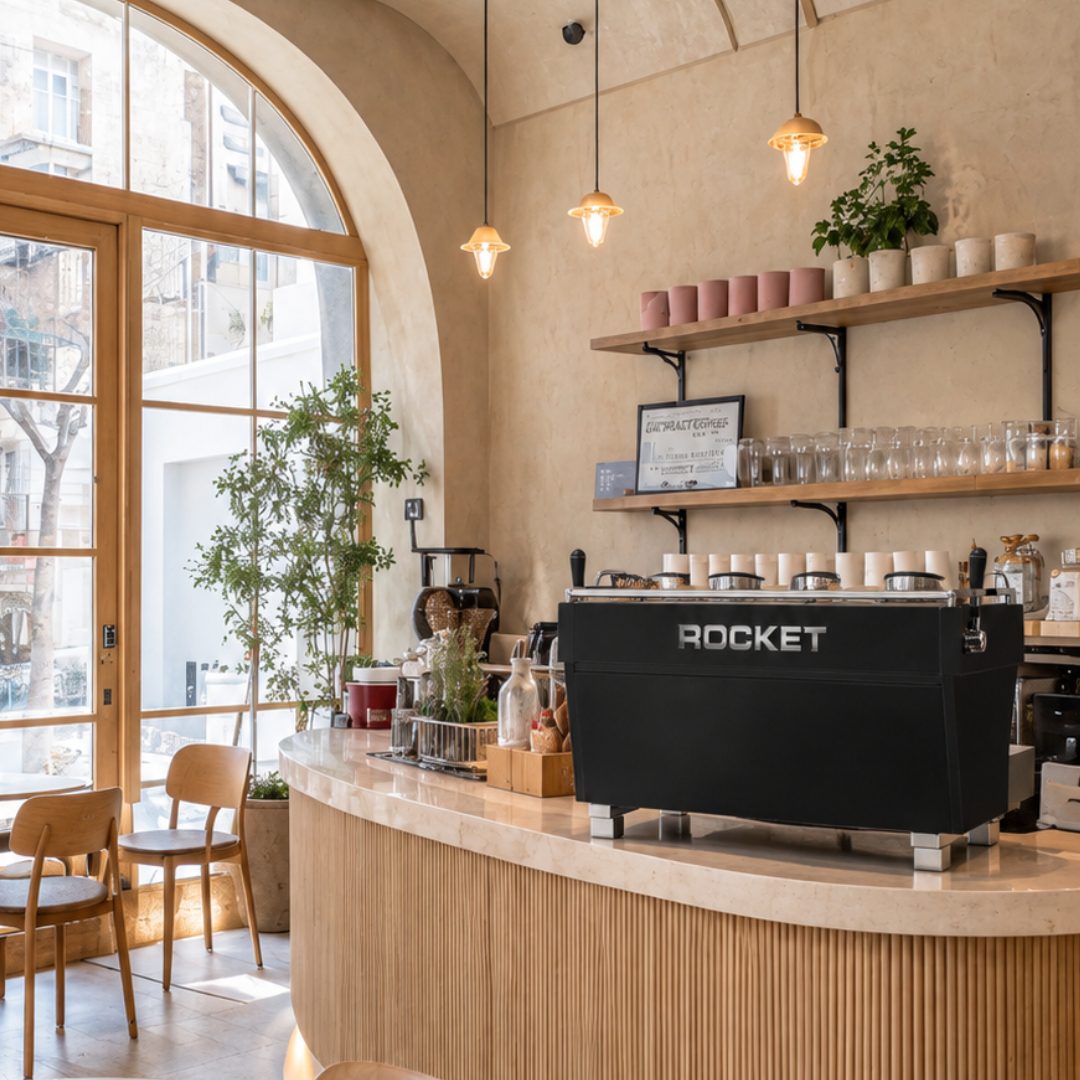
The result is thermal stability that barely moves. Pull ten shots in a row and deviation stays within a fraction of a degree. Add PID control and independent brew and steam boilers, and the barista becomes the only real variable left. The Rocket Espresso Doppia is a good example of the format: dual boiler, fully saturated group, built for high-volume service where consistency cannot slip during a rush.
The trade-offs are real. Saturated machines are heavier, take longer to reach operating temperature, and the group is not a simple part to service. You are buying stability and paying for it in weight, warm-up and investment.
Semi-saturated: the practical middle
Semi-saturated designs sit between the two. The group is heated by boiler water circulating through it, so it runs warmer and more stable than a plain E61, but it is not fully integrated into the boiler the way a true saturated group is.
For a lot of Indian cafés this is the sensible answer. Faster warm-up than a saturated machine, better recovery than E61, simpler servicing. If your volume sits between a quiet neighbourhood café and a full specialty bar, this is usually where the honest recommendation lands.
What this means for your cup
Temperature swing shows up in taste in predictable ways:
- A shot running two degrees cool tastes sour and thin, with a short finish.
- A shot running two degrees hot tastes bitter and dry, and the crema collapses quickly.
- Swings inside a single shot give you both faults in the same cup, which is the hardest problem to diagnose.
Group technology matters more as volume rises. One shot every ten minutes gives any group time to recover. Forty drinks in an hour does not. The same logic applies to your grinder: group head and espresso grinder have to be specified for the same volume, or the weaker one sets your ceiling.
Frequently asked questions
Is E61 outdated?
Not at all. It is exceptional at low to moderate volume and offers pre-infusion without electronics. It simply is not built for sustained high-volume service.
Does a saturated group need more maintenance?
Not more frequent, but more specialised. Backflushing and gasket schedules stay the same, though deeper work needs a trained technician. Check service coverage in your city before buying.
Can I fix consistency with a PID alone?
A PID controls the boiler, not what happens to water inside the group. It helps, but it cannot compensate for a group design that drops temperature under load.
Choosing for your bar
Match the group to your busiest hour, not your average day. Under roughly 80 cups, E61 is comfortable. Between 80 and 250, semi-saturated usually wins on value. Above that, saturated is worth the investment. Our guide to coffee machines for cafés and this walkthrough of how semi-automatic machines work cover the rest of the setup.
Still unsure? Tell the Kaapi Solutions team your peak-hour cup count, your split between espresso and milk drinks, and your counter space. We plan these setups for cafés, hotels and offices across India every week, and we will tell you plainly which group design your bar actually needs.
