

Ask ten business owners how they chose their coffee machine and most will talk about the brand, the model and the discount they managed to negotiate. Very few will mention their 9 am queue, their staff turnover, or who is going to clean the milk system on a Sunday night. That gap is usually where the regret begins.
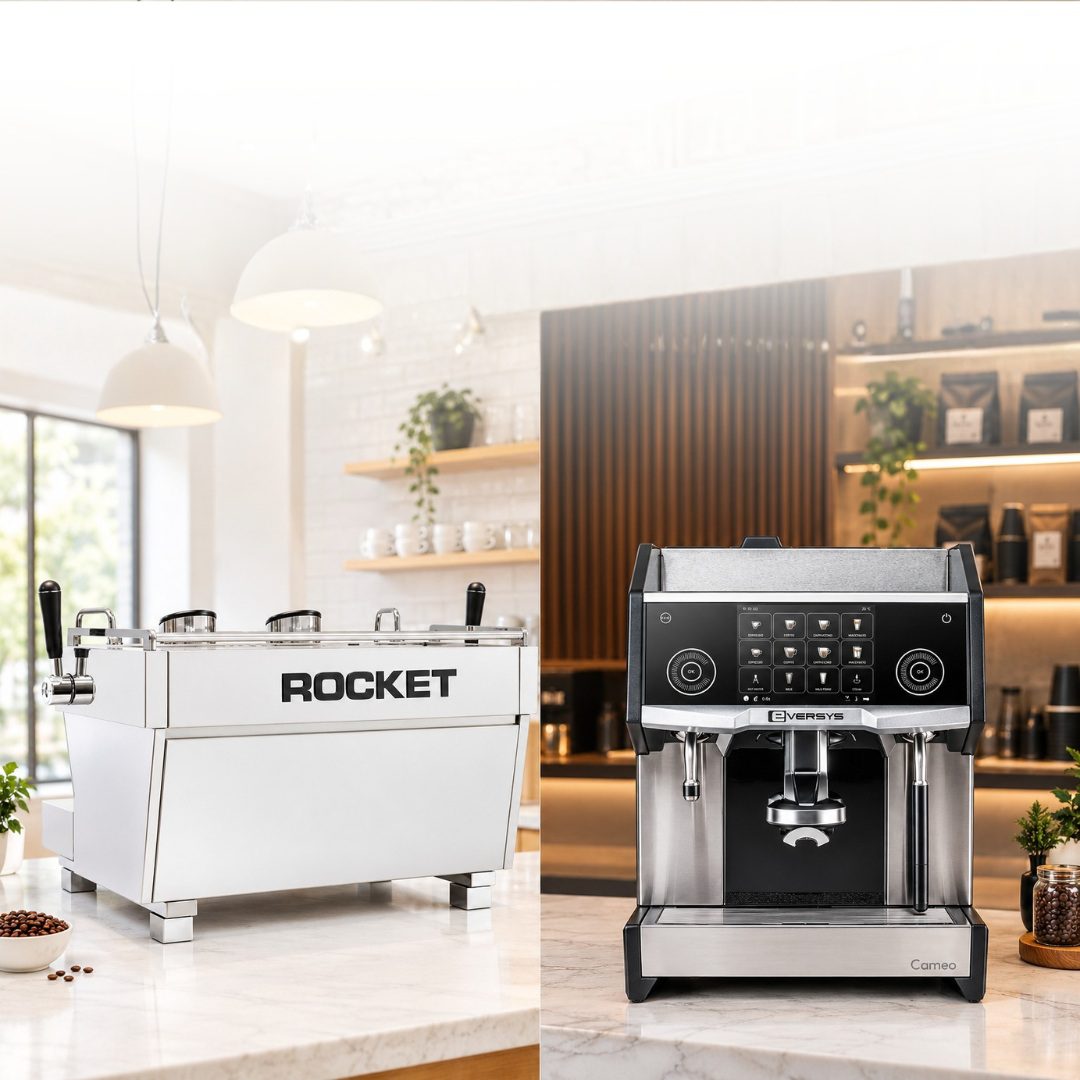
Two machine types dominate commercial coffee in India: the traditional espresso machine and the fully automatic bean-to-cup machine. Both make genuinely good coffee. What separates them is what they ask of your team, and the right answer depends on your volume, staff expertise, budget and customer expectations. Here is a practical comparison of commercial coffee machines for people who have to live with the decision, not just sign the invoice.
What Is a Commercial Espresso Machine?
A commercial espresso machine is a manual or semi-automatic machine where a person controls the shot. Everything you see on a cafe bar belongs to that process: the portafilter, the group heads, the steam wands, the knock box.
How Does an Espresso Machine Work?
Beans are ground fresh in a separate grinder, dosed into the portafilter, tamped level, locked into the group head and extracted under pressure. Milk is steamed by hand at the wand and textured for each drink. The barista is not decoration here. Grind, dose, extraction time and milk quality all sit in their hands, which is why the same machine can produce a remarkable cup and an ordinary one on the same shift.
Where Are Commercial Espresso Machines Commonly Used?
Cafes, specialty coffee shops, restaurants with a serious beverage menu, hotel dining rooms and premium hospitality venues. In short, businesses where coffee is part of the experience being sold and trained staff stand behind the counter. Most commercial espresso machines are specified in one-group, two-group or three-group configurations depending on peak-hour demand.
What Is a Bean to Cup Coffee Machine?
A bean-to-cup machine does the same job with the human steps engineered out. Whole beans go into the hopper, the machine grinds, doses, brews and disposes of the puck internally, and milk-capable models froth and pour on their own.
How Does a Bean to Cup Machine Work?
Someone presses a button. The machine grinds the dose, brews at a pre-set pressure and temperature, and adds milk or foam where the recipe calls for it. Because recipes are programmed, cup number four hundred tastes like cup number one. A cappuccino machine in this category can serve a full milk-drink menu without anyone learning to steam milk.
Which Businesses Benefit From Bean to Cup Machines?
Corporate offices and pantries, hotel breakfast and lobby counters, self-service corners, quick-service outlets, showrooms and co-working spaces. Broadly, any business that needs reliable coffee without a barista on the payroll. Commercial bean-to-cup coffee machines are built for exactly this situation.
Espresso Machine vs Bean to Cup Coffee Machine: Key Differences
The short version, before we get into the detail:
Factor | Espresso Machine | Bean to Cup Machine |
|---|---|---|
Operation | Manual / semi-automatic | Mostly automatic |
Barista skill | High | Low to moderate |
Customisation | Very high | Moderate |
Consistency | Depends on the operator | Highly consistent |
Speed | High with trained staff | Fast and convenient |
Staff training | More required | Less required |
Milk preparation | Usually manual | Often automated |
Maintenance | Regular manual cleaning | Automated cycles plus manual cleaning |
Customer experience | Premium, barista-led | Convenient, self-service |
Best for | Cafes and specialty coffee | Offices, hotels and self-service |
Coffee Quality: Which Machine Makes Better Coffee?
An espresso machine has a higher ceiling. Grind, dose, extraction time and milk texture can be adjusted cup by cup, which is why specialty cafes build their menu around one. A bean-to-cup machine has a higher floor: it grinds fresh, follows the recipe and never has an off day.
Is Espresso Always Better Than Bean to Cup?
No. A trained barista on a well-maintained espresso machine will beat an automatic machine at its best. But on a Monday with a new hire and a queue past the counter, bean-to-cup wins comfortably. The real question is not which machine is better in theory, but which risk your business can afford on its worst day.
Speed and Productivity: Which Is Better for Busy Businesses?
Start with cups per peak hour, not cups per day. A two-group espresso machine with an experienced barista clears a rush quickly because shots and milk run in parallel. Put an untrained person behind the same machine and the queue stops moving. Bean-to-cup machines deliver predictable throughput regardless of who is operating them, and one-touch preparation suits self-service areas. Their limit is brew-cycle time, so capacity must be matched to your busiest fifteen minutes, not your daily average.
Staff Training and Ease of Use
Espresso machines need trained operators who understand grind adjustment, dosing, recipe consistency and milk steaming, and someone has to retrain the next hire when that person leaves. Where attrition is high, that is a recurring cost. Bean-to-cup machines can be handed to general staff after a short walkthrough, which matters in offices, hotels and quick-service formats where the person making coffee also handles three other jobs.
Maintenance and Cleaning Requirements
Espresso machines need daily group-head cleaning, backflushing, steam-wand purging, grinder maintenance and water filtration checks. It is routine work, but it has to actually happen.
Bean-to-cup machines run automatic rinse cycles, though the brew group, milk system and grinder still need scheduled attention, along with descaling and filtration. Automation shifts the workload; it does not delete it. Across the full range of commercial coffee makers, the maintenance schedule is what separates a machine that lasts a decade from one that fails mid-rush.
Cost and ROI for Businesses
Judge total cost of ownership, not the figure on the quotation.
- Initial investment: an espresso setup needs a separate commercial grinder, tampers and pitchers. A bean-to-cup machine builds the grinder in, so it is never machine against machine alone.
- Operating costs: beans, milk, cleaning chemicals, water filtration, servicing and spares apply to both.
- Labour: this is where the gap widens. Espresso assumes skilled staff on every shift; bean-to-cup does not.
- Long-term ROI: cups served, revenue per cup, labour savings and downtime decide the return, not the purchase price.
For what changes at different investment levels, see our guide to commercial coffee machine price in India and our breakdown of what a commercial coffee machine costs to run.
Which Machine Is Better for Different Types of Businesses?
- Cafes: an espresso machine, in almost every case. Barista-led service is the product.
- Offices: bean-to-cup. Employees want a good cup in ninety seconds, not a menu. Our guide to office coffee machines covers the specifics.
- Hotels: usually both. Bean-to-cup for breakfast and lobby self-service, espresso for the restaurant and bar.
- Restaurants: it depends on menu positioning and whether service staff can handle a portafilter during a full dinner service.
- Specialty coffee shops: espresso machine. Control over extraction is the entire proposition.
Espresso Machine vs Bean to Cup: Pros and Cons
Espresso machines offer high control, full customisation and a premium counter presence. The trade-off is skilled staff, more manual work and quality that rises and falls with the operator.
Bean-to-cup machines offer simple operation, consistent drinks and self-service capability. The trade-off is less manual control, narrower customisation and internal components that must be maintained properly.
How to Choose the Right Coffee Machine for Your Business
Work through this checklist honestly before you shortlist anything:
- How many cups do you serve per day, and how many in your busiest hour?
- Do you have trained baristas, and can you keep them?
- Is coffee a core revenue line or a hospitality add-on?
- Do your customers expect specialty coffee?
- Do you need self-service operation?
- What is your budget across machine, grinder, installation and service?
- What counter space, electrical points and plumbing do you have?
- How much daily cleaning can your team genuinely commit to?
- Which drinks sell most: black coffee or milk-based?
- What after-sales support and spare-parts response do you need in your city?
Espresso Machine or Bean to Cup: Which One Is Better for Business?
Choose an espresso machine if you run a cafe or specialty coffee business, barista expertise is available and sustainable, and your customer experience is built around handcrafted drinks.
Choose a bean-to-cup machine if you need simple operation, the same cup every time, or self-service convenience with limited trained staff.
There is no universal winner. The best commercial coffee machine is the one that matches your workflow, your staffing reality and your customer expectations. A brilliant machine in the wrong environment underperforms a modest one in the right environment, every time.
Frequently Asked Questions
Is a bean to cup machine better than an espresso machine for business?
It is better for businesses that need consistency without trained baristas. For cafes selling barista-led coffee, an espresso machine remains stronger.
Which is cheaper to operate, espresso or bean to cup?
Bean-to-cup usually costs less in labour because it needs no skilled operator. Consumables and servicing costs are broadly comparable.
Which coffee machine is best for an office?
A bean-to-cup machine. Offices need one-touch operation, minimal training and consistent output through the day.
Do bean to cup machines require a barista?
No. General staff can operate them after a short briefing, and many models are built for full self-service.
Which machine makes better-quality coffee?
An espresso machine has the higher ceiling with a skilled barista. A bean-to-cup machine delivers a more consistent average cup.
Which is better for a busy cafe?
A multi-group espresso machine, provided you have trained staff. It handles peak volume and menu variety better than a single automatic unit.
Are bean to cup machines easy to maintain?
Easier, not maintenance-free. The brew group, milk system, grinder and water filter still need scheduled care.
How many cups can a commercial coffee machine make per day?
It varies widely, from around fifty cups for compact units to several hundred for high-capacity machines. Specify against peak-hour demand, not the daily total.
How do I choose the right commercial coffee machine for my business?
Assess volume, staff skill, drink mix, space and service support, then match those to the machine type. Our coffee machine dealer buying guide walks through the evaluation in detail.
Choose the Right Commercial Coffee Solution with Kaapi Solutions
Kaapi Solutions has been helping cafes, restaurants, hotels and offices across India specify the right equipment since 2007. We assess your volume, workflow and staffing before recommending anything, and every installation is backed by training, preventive maintenance, genuine spares and responsive service support. Browse our range of commercial coffee machines or speak to our coffee experts to find the machine that fits how your business actually runs.
