


Most café owners spend three weeks choosing an espresso machine and ten minutes choosing the grinder. Then they spend six months wondering why the 8 am shot tastes bright and the 4 pm shot tastes like burnt toast.
The machine is rarely the problem. The grinder usually is. Your espresso machine controls water, pressure and temperature. Everything else — dose, particle size, freshness — comes from the grinder next to it. Browse the full espresso grinder range and you will notice the split runs down one line: doser or on-demand.
What a doser grinder actually does
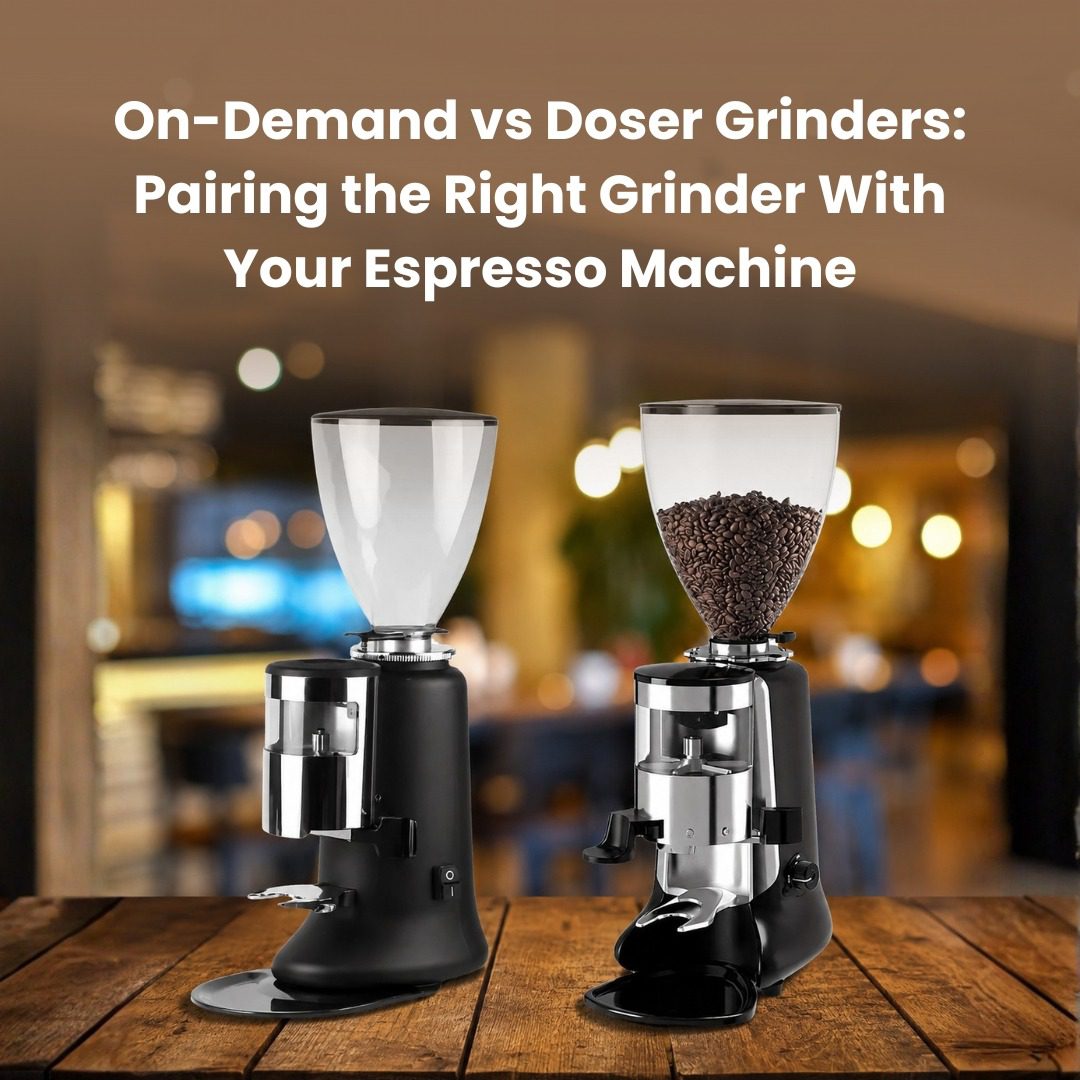
A doser grinder grinds into a small chamber divided into wedges. The barista pulls a lever, one wedge drops into the portafilter, and the shot goes on. Grind first, dose later.
That design was built for speed. During a banquet or a 9 am office queue, having 8–10 doses already waiting means the barista never stands around while the burrs run. Dosers are also mechanically simpler, so they usually cost less and have fewer electronics to service in a humid Indian kitchen.
The trade-off is freshness. Ground coffee starts losing aromatics within a couple of minutes of hitting air. If your chamber holds ten doses and you sell four an hour, six of those doses are going flat while they wait. There is also dose drift — a full chamber and a nearly empty chamber do not throw the same weight. The A-Series Manual grinder shows the format done properly: 64 mm flat burrs, stepless micrometric adjustment, around 4 kg output per hour. Built for steady mid-volume work, not a slow trickle of orders.
What an on-demand grinder does differently
An on-demand grinder holds nothing back. You place the portafilter, press once, and it grinds a programmed single or double straight into the basket.
For specialty cafés this is close to non-negotiable. Every shot uses coffee that was whole bean five seconds earlier, dosing runs on time or weight, and your recipe survives a shift change. Waste drops sharply too, which matters most on a premium single origin. Something like the A-Series Grind On Demand, with dial-based adjustment and an antistatic design, keeps grounds in the basket instead of on the counter.
The honest downside: you wait 6–10 seconds per dose, and in a brutal rush that adds up. Better on-demand grinders answer this with larger burrs and higher throughput.
Pairing it with your machine
Here is the practical matching logic:
- Single-group machine, 30–80 cups a day (kiosk, bakery, boutique café): on-demand. Volume is too low for a doser to stay fresh.
- Two-group machine, 150–400 cups a day: on-demand with 64–75 mm burrs. This is the standard specialty café pairing.
- Three-group machine, 400+ cups: on-demand as primary, plus a second grinder. Never make one grinder switch between blends all day.
- Banquet, catering or canteen service with sharp peaks and a single blend: a doser earns its place here, and often costs less.
- Fully automatic bean-to-cup: the grinder is already inside, so your decision is burr material and service interval.
One more rule worth respecting. If you are investing in a semi-automatic espresso machine, do not pair it with a bargain grinder. A good grinder on a modest machine beats a premium machine on a weak grinder almost every time. Budgeting roughly a fifth of the machine cost for the grinder is a sensible starting point.
Burrs matter more than the badge
Flat burrs give clarity and a tighter particle spread, which espresso rewards. Conical burrs run cooler and forgive a little more. Bigger burrs, 64 mm or 75 mm, grind faster and heat the coffee less. Also ask about retention: a grinder that traps 3 grams in the chute is quietly serving yesterday’s coffee at the start of every shift.
Frequently asked questions
Are doser grinders outdated?
No, just narrower in use. For high-peak, single-blend service they still make sense. For specialty cafés running variable volume, on-demand has become the default.
Can one grinder serve two espresso machines?
Technically yes, practically no. Two machines mean two workflows, and your baristas will end up queueing at the grinder during exactly the hour you cannot afford it.
How often should burrs be replaced?
Roughly every 500–800 kg for steel burrs, longer for titanium-coated sets. If shots start running fast and tasting thin at the same setting, the burrs are telling you something.
Choosing without second-guessing yourself
Start from your daily cup count and your menu, not the spec sheet. Low or uneven volume points to on-demand. Sharp, predictable peaks on a single blend make a doser defensible. If you are still building the setup, our guide to coffee machines for cafés pairs well with this one.
And if you would rather talk it through, the team at Kaapi Solutions plans grinder-and-machine pairings for cafés, hotels and offices across India every week. Tell us your volume, your blend and your counter space, and we will tell you honestly which format fits.
